More and more often health insurance policy is considered not as an additional option, but as an independent tool for financial protection. Illness rarely strikes in time and usually entails not only medical but also domestic, work-related and financial consequences. Even with an access to public healthcare, the costs of examinations, medications, rehabilitation and temporary loss of income can be significant.
Insurance works as a pre-determined commitment by the insurer to assist the insured person when certain events occur. However, the effectiveness of such a policy directly depends on understanding its logic. Misconceptions about insurance often lead to disappointment, while the correct comprehension of the terms allows for its intended use.
What health insurance is
Health insurance is a contract under which an insurance company undertakes to make a payment or provide medical care in the event of predetermined health consequences. The insured object is the property interests associated with a person's life and health, not the illness itself as a medical condition.
It is crucial that the insurance policy is always limited by the terms of the contract. It clearly specifies the period of validity, territory of coverage, the insured amount and the list of events that may be recognized as insurance. The contract comes into force upon payment of the insurance premium and is valid for the specified period.
The policy does not replace the medical system and does not guarantee the payment of any treatment. It operates strictly within the conditions agreed upon by the parties, and therefore requires careful review before purchase.
Diseases and events covered by the policy
Coverage under the policy is based on the risks the insurance company is willing to bear. As a rule, it is about the cases when an illness leads to objective and confirmed consequences for a person's health and ability to work. These may include conditions requiring treatment, medical supervision or temporary cessation of professional activity. Each event must be supported by medical documentation and occur within the term of the policy. A deterioration of health itself without medical attention is not recognized as an insured event.
Basically, the policies cover the following situations:
- Temporary disability. Conditions in which the disease results in the inability to perform work duties for a specified period;
-
- Inpatient treatment. Hospitalization and therapy in a medical facility as prescribed by a doctor;
-
- Diagnosed complications. Medical consequences of the illness, recorded in official documents;
-
- Medical interventions. Procedures and treatment directly provided by the terms of the insurance contract.
It is important to understand that the occurrence of the above-mentioned insured events does not guarantee the automatic payment. The insurance company evaluates compliance with all contract terms, including notification periods and the completeness of the documents provided. This process determines whether the incident will be recognized as an insured event.
List of insurance exclusions
Limitations and exclusions are a mandatory part of any insurance contract. They allow the insurance company to manage risks and exclude situations that cannot be objectively assessed or that were not originally included in the premium calculation. Not knowing these limits often causes controversy. A denial of payment is not always due to the insurer's negligence. In most cases, it is based on direct provisions of the contract with which the policyholder agreed to when purchasing the policy.
Most often, the following points are not recognized as insured events:
- Diseases diagnosed before the conclusion of the contract. Chronic and previously identified conditions;
-
- Exacerbations of existing illnesses. If the cause of declining health is related to a previously known diagnosis;
-
- Events outside the insurance period. Illnesses that arose before the start or after the end of the policy;
-
- Lack of medical reports. Cases not recorded in official medical documents.
These restrictions underscore the key principle of insurance: the policy protects against future risks, but not compensates for existing health problems. Therefore, the time of concluding the contract and the accuracy of the information provided are crucial.
How the policy works in practice
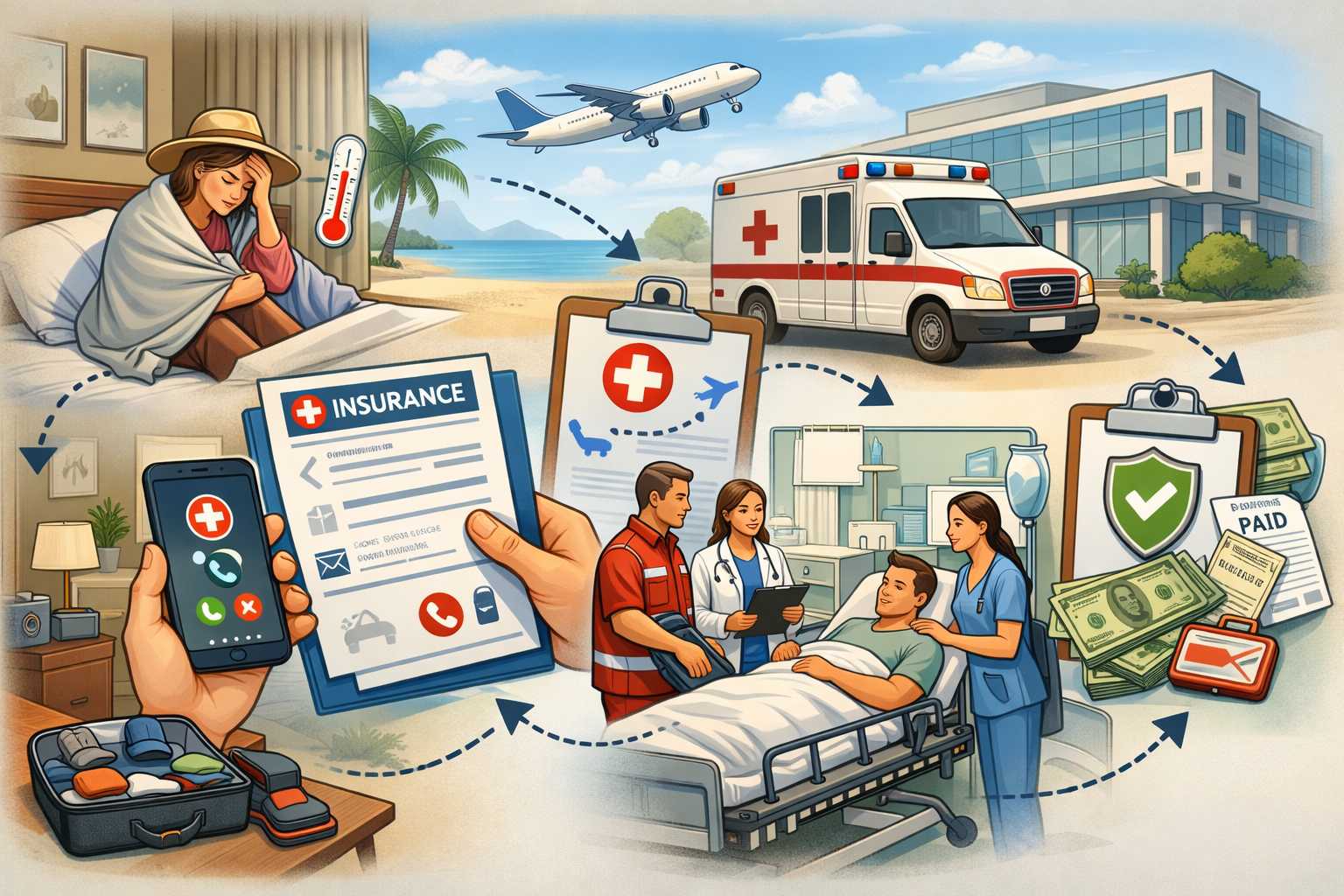
The insurance policy's mechanism can be roughly divided into several sequential stages. All are equally important and cannot be omitted without adverse effects. The breach of any stage may lead to a refusal of recognition of the insurance event. Insurance always requires active steps on the part of the insured. The policy is not automatic and requires adherence to established procedures.
In practice, the process is as follows:
- Occurrence of an event. Declining health requiring medical intervention;
-
- Seeking medical help. Recording the diagnosis and initiation of treatment;
-
- Notifying the insurance company. Reporting the event within the timeframes specified in the contract;
-
- Providing documents. Submitting medical certificates and other evidence;
-
- Making a decision. Review by the insurance company and issuing a conclusion.
After completion of the procedure, the insurance company either makes the payment or provides a reasoned refusal. In case of positive decision, the payout rate is determined within the insured amount and the terms of the contract. This process can take some time, which is also worth considering when planning your financial expectations.
Insurance coverage formats
Health insurance policies differ not only in the list of risks but also in the type of assistance. It influences how exactly the insured ones obtain support and what actions are required of them. The chosen option is fixed in the contract and cannot be changed retroactively after the insured event occurs.
The most common formats are:
- Cash payment. The insurance company transfers the amount to the insured person after the insured event is recognized;
-
- Payment for medical services. Payments are made directly between the insurance firm and the clinic;
-
- Combined format. Part of the assistance is provided in the form of services, and another one — in the form of payments.
Each format has its own specific features. Cash payments give freedom to dispose of the funds, but require time for document review. The direct medical care reduces the financial burden immediately, but is limited by the list of clinics and services specified in the contract.
Validity period and coverage area
The travel insurance policy's validity period is one of the basic parameters of insurance. It is always indicated in the contract and does not allow for flexible interpretation. Even if an illness begins on the last day of the policy's validity, the key moment is the occurrence of the event, as documented by medical records.
The insurance territory is no less important. Most policies are valid within a specific country or region, and treatment outside may not be covered at all. This is especially true for people who travel frequently or live in multiple countries.
Understanding these limitations allows you to assess in advance in which situations the policy will actually work and in which it will not.
When health insurance is especially important
Health insurance becomes especially important during periods when financial stability directly depends on health. For the self-employed, entrepreneurs and people with irregular income, temporary disability can lead to significant losses. A policy is also relevant in the absence of advanced health services or need to plan expenses in advance. It does not solve all problems, but allows reducing uncertainty and establishing a basic level of protection.
Health insurance policy is a tool that operates according to strict rules and does not allow for arbitrary interpretation. Its effectiveness is determined not by promises, but by the terms of the contract, validity periods, exclusions and the correct actions of the insured person. A conscious approach to insurance allows you to use the policy for its intended purpose and view it not as a mere formality, but as part of a well-thought-out personal financial security system.